News
Stay tuned for the latest news of events, product release, features, updates, tips and more.



Date: 2026-08-19 1320
BIM World: The construction industry is increasingly moving from drawing-based CAD processes towards model- and data-driven BIM workflows. What does this fundamentally change for designers, planners and project stakeholders?
William Wang: The shift from drawing-based CAD to model- and data-driven BIM is real, but I would frame it carefully: it is convergence, not replacement. Across Europe, CAD remains the foundation of day-to-day design work, even as BIM adoption continues to grow.
What changes fundamentally is not the tool, but the expectations around it. Designers, planners and project stakeholders now need drawings, models and structured data to flow together. For designers, BIM introduces information-rich models that allow geometry, engineering data and project information to stay connected throughout the project lifecycle. For planners, it turns isolated models into shared sources of truth. For stakeholders, it means decisions are backed by live information rather than static files.
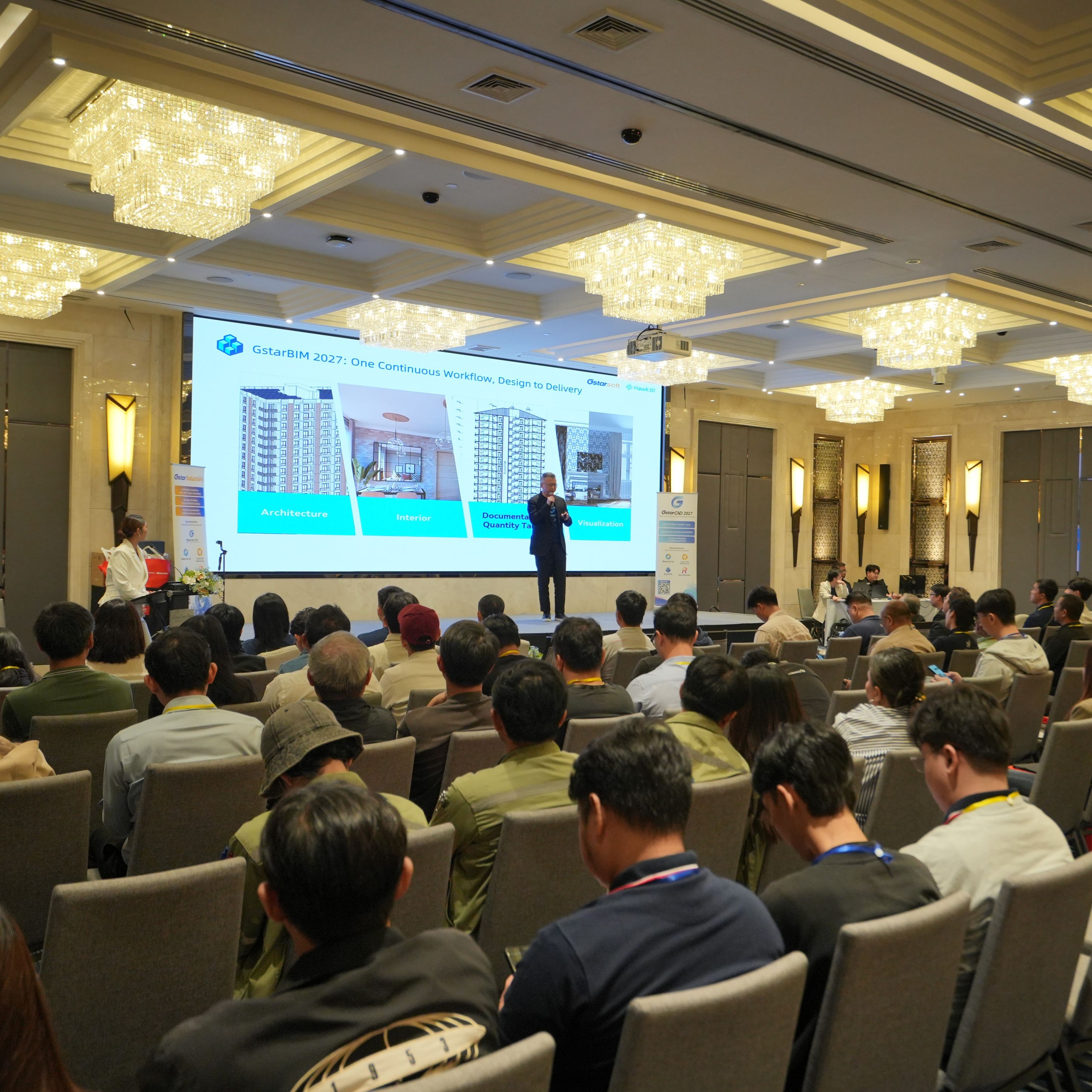
The risk is treating BIM as something that forces teams to abandon proven CAD assets. We believe the better path is to connect the two. GstarBIM 2027 integrates architectural, MEP and interior workflows while strengthening BIM collaboration, and GstarCAD 2027 remains the front of the engineering value chain. The real change is moving from exchanging files to exchanging information — and that is where GstarCAD 365 and our cloud platform remove the silos between design, review, approval and operation.
BIM World: Many design offices still work extensively with traditional CAD and DWG-based processes, while BIM requirements continue to increase. What is needed to make this transition work in practice?
William Wang: In my experience, the transition only works when it respects where offices actually are today. Most firms are not starting from zero — they have decades of DWG-based knowledge, trained habits and project pipelines. What is needed is not a forced migration, but a bridge.
Practically, that means three things. First, performance and stability on the tools they already use, so adoption never feels like a downgrade. Existing CAD workflows need to remain reliable, while at the same time opening a realistic path towards model-based processes.
Second, a realistic on-ramp from 2D to 3D is needed. This requires advanced 2D-to-3D conversion, point cloud modelling and AI-assisted visualization. This enables teams to develop models from existing drawings instead of redrawing everything from scratch.
Third, the barriers to entry need to be low. Smaller design offices, too, should be able to start collaborating without having to invest heavily in infrastructure. Architecture and engineering firms need to be able to evolve step by step and at a controllable cost — through lightweight architecture, flexible licensing and cloud deployment.
The goal is simple: meet teams where they are, and let BIM grow around the CAD they already trust.
BIM World: BIM projects are not just about 3D models, but above all about structured information. What requirements does a good BIM model need to meet in order to be truly useful across planning, coordination and execution?
William Wang: A good BIM model earns its value not from how impressive it looks, but from the information it carries and how reliably that information travels.
Across planning, coordination and execution, I would say a useful model needs four qualities. It must be structured — geometry without data is just a pretty picture. It must be open — locked formats break the chain the moment a stakeholder uses different software. It must be verifiable — design rules and engineering information should be checkable, not assumed. And it must be continuous — usable from first sketch to operation and maintenance.
This is why we put open standards at the center. For a model to remain useful across multiple project phases, information should not only be stored, but continuously checked, commented on and reused.
In short, a model is only as good as the structured, open and continuous information behind it.
BIM World: OpenBIM and interoperability are considered key prerequisites for successful digital collaboration. What role do open standards such as IFC play in enabling different software solutions and project stakeholders to work together reliably?
William Wang: Open standards such as IFC are, quite simply, the foundation of digital construction. The moment a project involves multiple disciplines, contractors and owners, software diversity is inevitable, and the only thing that keeps that diversity from becoming chaos is a common, vendor-neutral language.
IFC provides exactly this common, vendor-neutral language for exchanging building information. - This includes IFC-based collaboration as well as open interfaces that partners and developers can build on.
Digital transformation is no longer about individual tools — it is about connecting people, workflows, data and expertise across the entire design ecosystem. An open platform is the only way to do that honestly.
BIM World: Many companies are looking for greater software independence while hoping to continue using their existing workflows with minimal disruption. How important are compatibility, user habits and avoiding vendor lock-in for the adoption of digital planning tools?
William Wang: These factors are decisive — arguably the dividing line between tools that get adopted and tools that get abandoned. Compatibility protects the investments companies have already made: their DWG libraries, their trained habits, their project history. User habits are not friction to be eliminated; they are accumulated expertise that should be preserved. And avoiding vendor lock-in is what keeps a company's future choices open.
That is why digital planning tools need to support existing formats, working methods and platforms as well as possible. When teams move to the cloud or adopt new collaborative functions, this should feel like a continuation — not a rupture with what already works in the office.
In my view, software independence is not about rejecting integrated platforms. It means choosing platforms in a way that allows companies to remain in control and retain their data if requirements, projects or technologies change.
Open formats, cross-platform support and transparent licensing are how we give customers that freedom. Adoption follows when disruption is minimal and control stays with the user.
BIM World: Looking five years ahead, will CAD and BIM continue to exist as separate worlds, or are we moving towards a more integrated planning environment where drawings, models and structured data naturally work together?
William Wang: I am confident we are moving toward an integrated environment — and honestly, the separation was always more artificial than real. In five years, drawings, models and structured data will simply be different views of the same engineering truth.
CAD will remain the front of the value chain, the place where intelligent engineering begins, while BIM carries that intelligence forward into coordination and delivery.
What will matter is that drawings, models, visualizations and structured data no longer exist side by side, but function as one connected information base.
The throughline is continuity: information must be carried forward from the first design stage into later project phases.
Five years from now, the question will not be “CAD or BIM” — it will be “how seamlessly do they work as one?”
2026-09-21
2026-09-17

2026-08-19

2026-07-27

2026-06-17

2026-04-02

2026-01-14

2025-11-27
